Workflow Management vs. Task Management: What's the Difference?
Task management is the practice of organizing individual units of work — capturing tasks, prioritizing them, tracking them to completion. Workflow management is the practice of structuring the paths that connect units of work — the sequence, handoffs, and ownership that carry an item through multiple steps and multiple hands. The difference is connective tissue: task management sees the pieces; workflow management sees how the pieces join. A team can be excellent at one and terrible at the other, and the failure modes look completely different.
This is the smallest-seeming distinction in the workflow vocabulary and the one with the widest practical consequences, because task tools are where nearly everyone starts — and the ceiling of task thinking is where most teams quietly get stuck.
Two Different Objects of Attention
Task management attends to the item. A task is a discrete unit: review the contract, update the pricing page, call the vendor. Task management's questions are item-scoped: What needs doing? How urgent is it? Who's doing it? Is it done? The discipline has a rich personal-productivity lineage — from the humble to-do list through systems like Getting Things Done — and its instincts reflect that origin: capture everything, clarify it, prioritize it, and work the list. Done well, task management ensures nothing an individual owns gets forgotten.
Workflow management attends to the path. Its unit is the journey a piece of work makes between people: the contract that goes from sales to legal to finance to signature. Its questions are path-scoped: What triggered this? What's the sequence? Where does responsibility transfer? Whose move is it right now? What does done mean for the whole journey, not just my leg of it? Done well, workflow management ensures nothing gets lost between individuals — which is where, in team settings, most things get lost.
The bricks-and-archway image holds the distinction: tasks are bricks; a workflow is the archway. You can stack bricks conscientiously — every brick accounted for, none forgotten — and still have no arch, because an arch isn't a quantity of bricks; it's a structure of relationships among them. Ten perfectly managed task lists on a ten-person team can coexist with work that stalls for weeks, as long as the stalls happen in the spaces between the lists.
The Gap Between the Lists
The signature failure of task-managed teamwork deserves its own name, because everyone has lived it: the handoff gap. Person A finishes their task and checks it off. The work now needs Person B — but B's list doesn't know that yet, or knows it as an unranked item with no context, no deadline inheritance, and no visibility to anyone else. The work item is, for practical purposes, nowhere: A's list says done, B's list says nothing urgent, and the person waiting on the outcome sees only silence. Multiply by every transfer in a multi-step path, and you get the defining pathology of task-tool teamwork — everything is tracked, and nothing is flowing.
Task management has no native answer to this, because the gap isn't on anyone's list. It lives between lists — and between is exactly the territory workflow management claims: explicit handoffs, stage ownership, and a single answer to "where is this item?" that doesn't depend on assembling ten personal views.
The Differences, Side by Side
Dimension | Task Management | Workflow Management |
Unit of concern | The discrete task | The path across tasks and people |
Scope of visibility | My list (or my team's lists) | The whole journey of each item |
Core question | What needs doing, and is it done? | Where is this item, and whose move is it? |
Handoffs | Implicit — via assignment or mention | Explicit — defined transfers with ownership |
Sequence | Priority order within a list | Dependency order along a path |
"Done" means | The task is checked off | The item completed its full journey |
Native habitat | Individual work; small, flat teams | Multi-step, multi-person work |
Lineage | Personal productivity (to-do lists, GTD) | Process and routing tradition (WfMC lineage) |
Failure it prevents | Forgotten commitments | Work lost between people |
Which One Your Problem Calls For
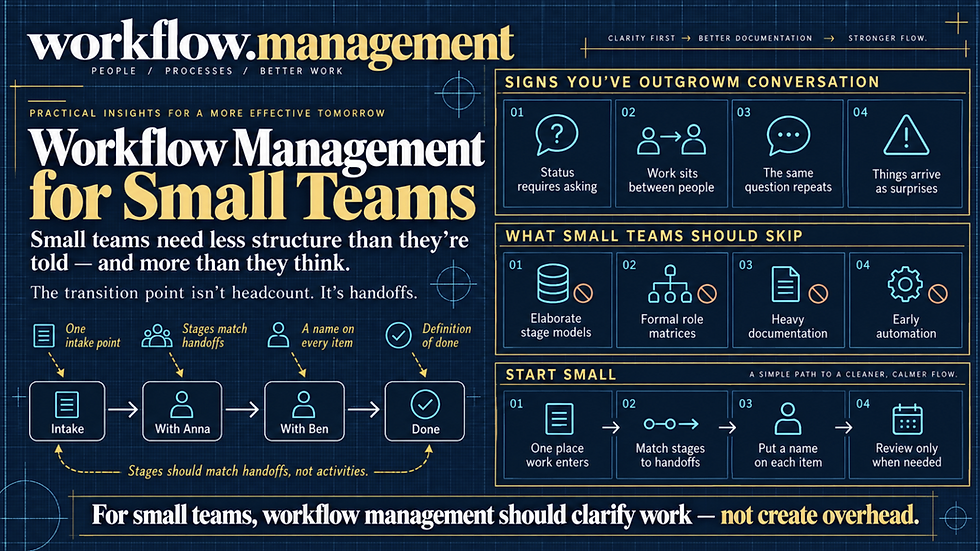
Task management is enough when the work is genuinely individual, or the team is small and flat enough that coordination happens in conversation: few steps, few transfers, everyone sees everything. In that setting, adding workflow structure is bureaucracy — the overhead of stages and handoff rules exceeds the coordination it buys. Plenty of two- and three-person teams run beautifully on shared lists and should keep doing so.
You've outgrown task management when the telltale gap symptoms appear: items that are "done" on one person's board and invisible on the next person's; a daily ritual of asking around for status; deadlines missed not because anyone was idle but because the work sat unclaimed between owners; and the tool filling up with meta-tasks — check with legal, follow up on the follow-up — which are the manual labor of simulating a workflow inside a task tool. Meta-tasks are the diagnostic to watch: every one of them is a handoff or a status check that a structured path would have made automatic.
The trap to avoid is scaling the wrong discipline. Teams feeling the gap usually respond with more task management — better labels, more diligent assignment, stricter list hygiene. It doesn't work, because the failure isn't in how items are tracked; it's in the absence of connective structure. No amount of brick discipline produces an arch. The fix is a different kind of effort entirely: define the recurring paths — trigger, stages, handoffs, owners, completion — and let tasks live inside that structure.
How They Work Together
The mature arrangement isn't a choice between the two; it's nesting. Workflows provide the structure; tasks populate it. Each stage of a defined path generates the concrete tasks someone works on, and each person still manages their own queue — but the queue is fed by the workflow, arrives with context and sequence attached, and reports its completion back to the path. The individual keeps the virtues of task management (nothing forgotten, clear priorities); the team gains the virtues of workflow management (nothing lost between people, one authoritative answer to "where is it?").
Modern work platforms mostly support both layers; the discipline is in using them as layers. A board where every card is a free-floating task is task management wearing workflow clothing. The same board with defined stages, explicit ownership per stage, and cards that move because handoffs happened is the real thing.
FAQ
What's the difference between a task and a workflow? A task is a discrete unit of work — one action, one owner, checked off when finished. A workflow is the structured path a piece of work follows across multiple tasks, people, and handoffs, from trigger to completion. Tasks are the pieces; the workflow is how the pieces connect.
Is task management part of workflow management? They nest rather than contain. Workflow management structures the paths; task management handles the discrete work inside each stage. A healthy setup runs both as layers: the workflow feeds each person's task queue, and completed tasks advance the workflow.
When is task management not enough? When work regularly passes between people. The gap between one person's "done" and the next person's "started" is invisible to task tools — nothing on any list represents it. If status requires asking around, items sit unclaimed between owners, or your tool fills with follow-up meta-tasks, the work has outgrown list-based coordination.
Can a task management tool do workflow management? Often, mechanically — most modern tools offer stages, assignments, and automation. Whether workflow management actually happens depends on configuration and discipline: defined stages, explicit ownership at each stage, and real handoff behavior. The tool category matters less than whether the connective structure exists.
Is a to-do list app enough for a small team? Frequently, yes. If the team is small enough that everyone sees everything and transfers happen in conversation, shared lists plus discipline work fine — and workflow structure would add overhead without buying coordination. The transition point arrives with multi-step paths and regular handoffs, not with headcount alone.