Workflow Management for Small Teams
Small teams need workflow management less than they're told and more than they think.
Less, because most of what's written about workflow management assumes coordination problems that a five-person team doesn't have. When everyone can see everything and a question gets answered by turning around, elaborate structure buys clarity you already possess — and costs maintenance you can't spare. Plenty of small teams run beautifully on a shared board and conversation, and should keep doing exactly that.
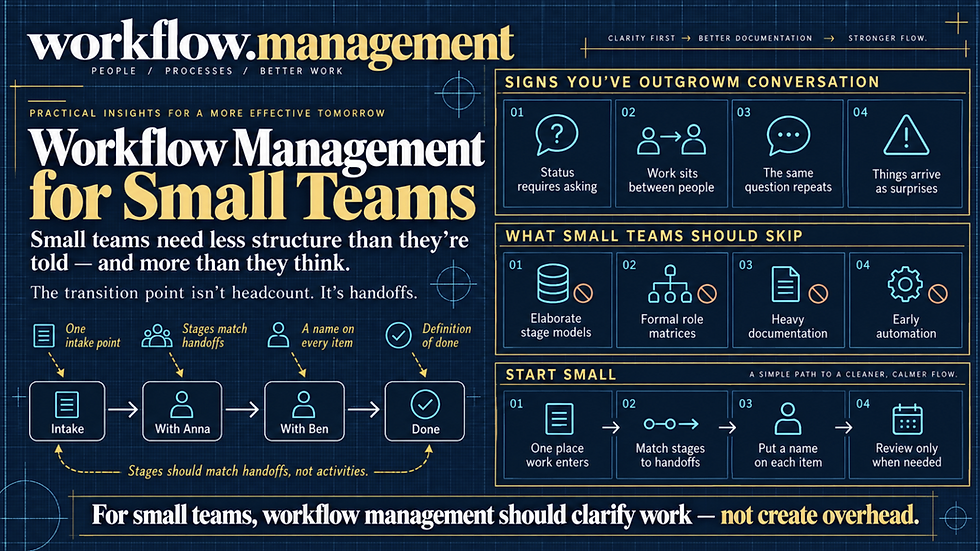
More, because the transition point isn't headcount. It's handoffs. A three-person team with work that passes between all three has more need for structure than a fifteen-person team of people working independently. Small teams often cross that line without noticing, because they attribute the resulting friction to being busy rather than to being unstructured.
The Signals That Matter
Four symptoms mean the work has outgrown conversation-based coordination, regardless of team size:
Status requires asking. If knowing where something stands means messaging someone, the coordination cost has already started scaling with volume. On a small team this is easy to dismiss — asking is quick — but it's the earliest reliable signal.
Work sits between people. Something is finished on one person's side and hasn't started on the next person's, and nobody knows how long it's been there. This is the handoff gap, and it appears at any size the moment work transfers.
The same question gets asked repeatedly. "Who's handling the Henderson request?" recurring weekly means ownership isn't visible, which is a structural problem with a five-minute fix.
Things arrive as surprises. A request that was made three weeks ago in a channel nobody tracks, surfacing as urgent. That's an intake problem, and small teams are especially exposed to it because informal intake feels natural when everyone is reachable.
If none of these are happening, you don't have a workflow problem, and adding structure now would be solving a problem you don't have.
The Minimum That Works
For a small team crossing the threshold, the whole intervention is four things. Not a system, not a methodology — four decisions.
One place work enters. A single intake point, whatever it is: a form, a shared inbox, one specific board column. The requirement isn't sophistication; it's singularity. Work that enters through four channels cannot be tracked, prioritized, or measured, and the informal channels are where the surprises come from.
Stages that match your handoffs. Not activity stages — transfer stages. If work goes from Anna to Ben to done, you have three: with Anna, with Ben, done. Most small teams need three or four. If you've drawn seven, you've drawn activities.
A name on every item. Whose move is it, visible without opening anything. This single element does more work than any other, and it's the one most often skipped on small teams, where "we all know" feels true until it isn't.
A definition of done. One sentence. Small teams lose more time to ambiguous completion than they expect — work that's finished-but-not-delivered, or delivered-but-not-confirmed, accumulating quietly.
That's it. Four elements, implementable in an afternoon, in whatever tool you already have.
What Small Teams Should Skip
Structure is a cost, and at small scale much of the standard apparatus costs more than it returns.
Elaborate stage models. Six-plus stages on a small team means most transitions are one person moving their own work between columns — pure overhead with no clarity gained.
Formal role matrices. RACI and similar models earn their keep when authority is genuinely unclear across organizational boundaries. On a team where everyone knows who decides, a matrix documents what everyone already knows and then goes stale.
Heavy documentation. A one-page description is plenty. Small teams change how they work frequently, and documentation maintenance scales with detail — a thorough document written in March is a wrong document by June.
Metrics dashboards. The useful measurement at small scale is the age scan: sort in-flight work by time in its current stage, look at it occasionally. Cycle-time trend analysis needs more volume than small teams generate to mean anything.
Automation, early. Most small-team automation fires notifications between people who are already in constant contact. The exception is worth naming: handoff automation still earns its place if transfers depend on someone remembering, since that's the failure mode that survives at any size.
The Small-Team Advantages
Two things small teams have that larger ones don't, and both are worth using deliberately.
Changes take effect immediately. A workflow change on a small team is a conversation, not a rollout. This means you can afford to treat structure as experimental — try a stage split, see if it helps, undo it in a week. Larger organizations can't iterate that cheaply, which is why they over-design in advance. You don't have to.
Informal repair still works. When something falls through, a small team can catch and fix it in conversation. This is a real advantage and also a trap: it masks structural problems, letting a workflow that's failing quietly look like a team that's busy. The useful discipline is noticing how often informal repair is happening. Occasionally is fine. Daily means the structure is doing none of the work.
The Failure Mode to Avoid
The characteristic small-team failure isn't too little structure — it's adopting too much, abandoning it, and concluding that workflow management doesn't apply to teams this size.
The sequence is predictable: friction prompts a search, the search returns content written for enterprise-scale coordination, the team implements a version of it, maintenance exceeds benefit within a month, and the board goes stale. What's left is a team that now believes structure is overhead, which makes them resistant to the four-element version that would actually have helped.
If you're starting, start smaller than feels serious. Add structure when a specific problem demands it, not in anticipation. Four elements that get maintained beat twelve that get abandoned, and the four are where most of the benefit lives anyway.
When You Grow
The structure above holds longer than most people expect — through roughly a doubling of team size, in practice. The things that break first, in order:
Ownership becomes ambiguous when there are enough people that "everyone knows" stops being true. Named ownership per stage is the fix, and it's already in the four elements.
Intake overflows when request volume exceeds what one person can triage informally. Structured capture with routing information is the fix.
Waits become invisible when the team is large enough that you can't see everyone's queue. This is when measurement starts earning its keep — and when the age scan should become a recurring look rather than an occasional one.
None of these require replacing what you built. They require adding to it, which is the advantage of having started minimal.
FAQ
Do small teams need workflow management? It depends on handoffs, not headcount. If work regularly passes between people, structure helps at any size. If everyone works independently and coordination happens in conversation, formal workflow structure adds overhead without buying clarity. The signals to watch are status requiring a question, work sitting between people, repeated ownership questions, and requests surfacing as surprises.
What's the minimum workflow structure for a small team? Four things: one place work enters, stages that match where work changes hands, a visible name on every item, and a written definition of done. That's implementable in an afternoon in whatever tool you already use, and it covers most of what larger structures provide.
How many stages should a small team's workflow have? Usually three or four — one per point where work changes hands, plus done. More than that generally means stages were drawn around activities rather than handoffs, which adds transitions without adding clarity.
Should a small team use RACI or formal role models? Rarely. Formal role matrices earn their cost when authority is unclear across organizational boundaries. On a small team, they document what everyone already knows and then go stale. Naming an owner per stage accomplishes the part that matters.
When does a small team outgrow informal coordination? When informal repair becomes routine rather than occasional — work regularly rescued by someone noticing, rather than by the structure. Frequency is the signal: catching a dropped handoff now and then is normal, and doing it daily means the structure isn't carrying any of the load.


